















One of the things people who move to Didcot are often surprised by is how quickly you can be somewhere that feels completely rural. The town itself sits in a flat stretch of the Thames Valley, but within 15 or 20 minutes in almost any direction you are into proper countryside. Chalk hills, ancient woodland, riverside meadows, Iron Age hillforts. It is genuinely good walking country, and most of it is free, accessible and largely uncrowded.
Here are the walks worth knowing about.
Wittenham Clumps
Wittenham Clumps is the obvious one, and it earns the reputation. The two hills, Round Hill and Castle Hill, sit about four miles northeast of Didcot and are managed by the Earth Trust. Castle Hill is the site of an Iron Age hillfort and once had a famous carved tree known as the Poem Tree, which fell in 2021 and has since been commemorated with a stone carving at its base. From the top of either hill you get 360-degree views across the Thames Valley, the Oxfordshire Downs and, on a clear day, well beyond. It is the kind of view that makes the area feel bigger than it is.
The most popular starting point is the Earth Trust car park at Little Wittenham, but you can also walk out from Didcot itself through Long Wittenham, crossing the Little Wittenham Bridge over the Thames. The bridge was formerly a venue for the annual World Poohsticks Championships, which is a detail that tends to go down well with younger walkers. Livestock graze on the hills so dogs need to be kept on a lead in places, and the paths can get muddy after rain.
The Ridgeway at Blewbury
The Ridgeway is one of the oldest roads in Britain, an ancient chalk trail that has been used for thousands of years. You can access it from Blewbury, which is only about two and a half miles south of Didcot, and follow it west across the North Wessex Downs. The walking here is wide open and quiet, with views across the Vale of White Horse and chalky grassland underfoot. It is a completely different feel to the Thames Valley walks, and on a clear morning it is hard to beat.
The Blewbury Chalk Pit is also worth a detour. It is a lesser-known spot but consistently well-reviewed by local walkers, particularly in spring and early summer when the chalk grassland fills with orchids and butterflies.
White Horse Hill and Uffington
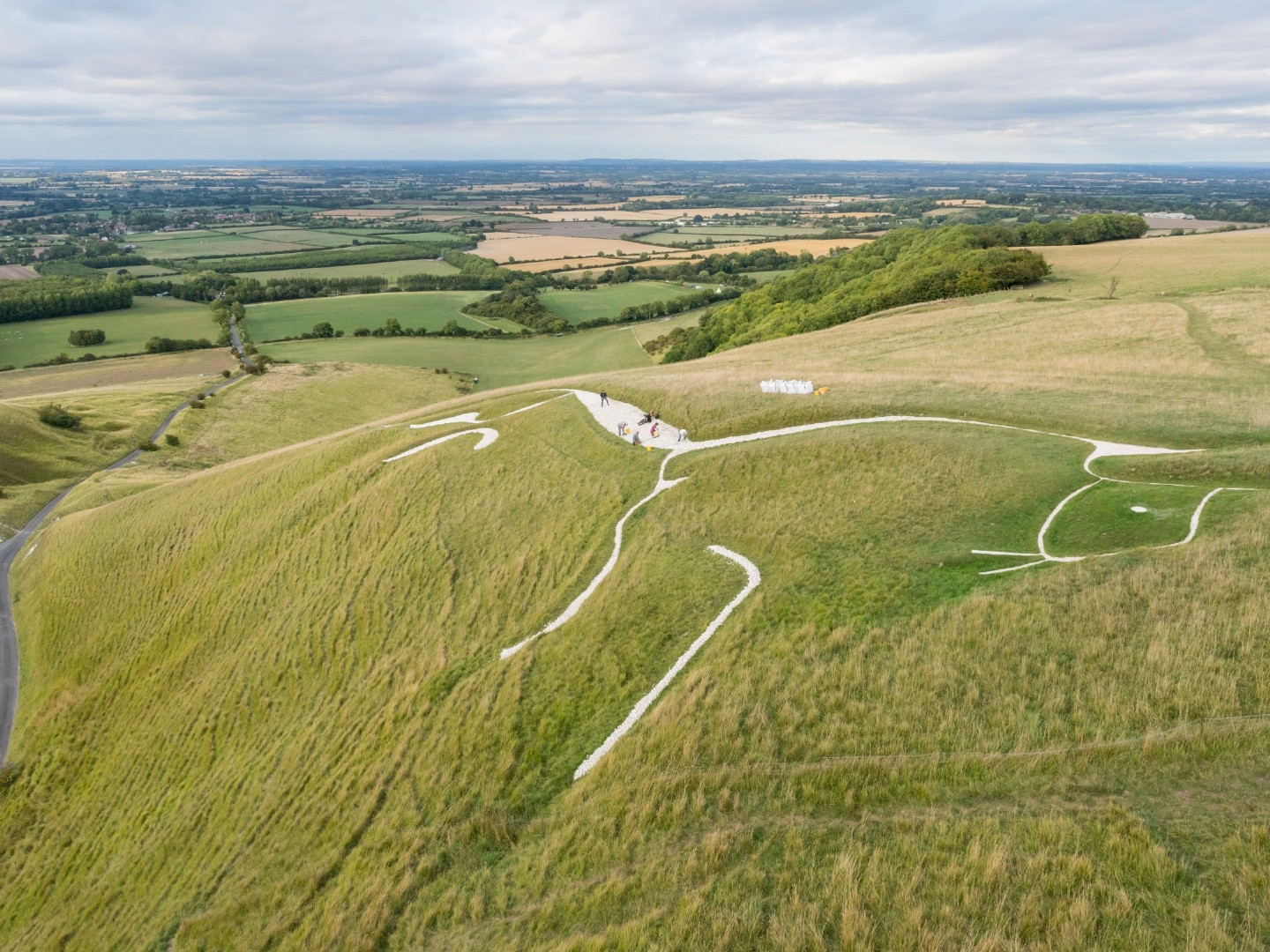
White Horse Hill is about 20 minutes from Didcot by car and is one of the most distinctive landscapes in the south of England. The chalk figure of the Uffington White Horse dates back around 3,000 years and is best seen from a distance, which the surrounding footpaths are well-positioned for. The National Trust car park at Woolstone is the most convenient starting point. From there you can walk across to Wayland's Smithy, a Neolithic long barrow that feels genuinely ancient and atmospheric, particularly on a quiet weekday morning. The Ridgeway connects the two, so you can do a straightforward circular route without any navigation difficulties.
The Thames Path at Dorchester-on-Thames
Dorchester is about eight miles from Didcot and worth the short drive for a riverside walk. The village itself is lovely, with Dorchester Abbey, the George Hotel and the Fleur de Lys all worth a look before or after you head out. The Thames Path from Dorchester loops around the Wittenham Clumps and takes in Day's Lock and the surrounding meadows. It is flat, well-marked and pretty much year-round accessible. You can extend it into a longer circular route taking in Little Wittenham and back through the fields.
The Disused Railway Path to East Hagbourne
This one is right on Didcot's doorstep and easy to overlook in favour of the bigger walks further out. The former Didcot, Newbury and Southampton Railway line has been converted into a traffic-free path and links Didcot to East Hagbourne and Upton. It is level, surfaced and lined with hedgerows and wildflowers. Good for a short evening walk, good for families with younger children, and easy to incorporate into a longer circular route through the farmland around East and West Hagbourne.
The Harwell and Icknield Way Circular
The walk around Harwell village and out along the Icknield Way gives you a good mix of village lanes, farm tracks and open downland. The Icknield Way is one of the oldest trackways in Britain, running along the base of the chalk escarpment, and the stretch near Harwell and Chilton is quiet and easy going. Horses are regularly exercised on the gallops in this area, so it is worth being aware of that if you are walking with a dog.
Mowbray Fields, Didcot
For an after-work walk without getting in the car, Mowbray Fields on the south side of Didcot is the local nature reserve and has a network of paths through a Millennium woodland and open grassland. It connects onto the old railway path and gives you an easy circuit of a couple of miles. Not the most dramatic walking in the area, but useful to know about when time is short.
Why it matters for people thinking about moving here
The reason this is on a mortgage broker's website, rather than a walking club's, is that access to green space and countryside is one of the things people most commonly mention when they are weighing up a move to Didcot from a city. It is a fair question to ask, and the honest answer is that the walking on your doorstep here is genuinely good.
Frequently Asked Questions
Wittenham Clumps is around four miles northeast of Didcot town centre. By car it is about 10 to 15 minutes, depending on where you are starting from. It is also walkable directly from Didcot through Long Wittenham, which adds around 45 minutes to an hour each way but takes you through pleasant countryside and across the Little Wittenham Bridge over the Thames. The Earth Trust car park at Little Wittenham is the most convenient starting point if you are driving.