












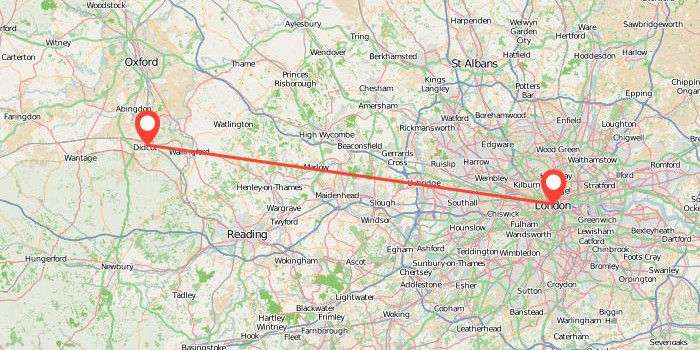



Every year a steady stream of people leave London for Didcot. Some are priced out, some are starting families and want more space, some have just had enough of the city and fancy a garden. Whatever the reason, it's a move that's worth thinking through carefully, because the experience varies a lot depending on what you're used to and what you're looking for.
Here's a reasonably honest take.
The commute
This is usually the first question, and the honest answer is: it depends on where in London you're coming from and where in Didcot you'd be going to.
The fastest trains from Didcot Parkway to London Paddington take around 37 minutes, with most services coming in somewhere between 40 and 55 minutes. There are over 100 trains a day on the route, so you're rarely stuck waiting. From Paddington you're on the Elizabeth line or the tube, which adds time depending on your final destination. If you work in the City or Canary Wharf rather than somewhere central, realistically you're looking at a door-to-door journey of around 90 minutes each way on a normal day.
That's a proper commute. It's manageable, especially if you only need to go in two or three days a week, which is the pattern most hybrid workers have settled into. But if you're in the office every day, it's worth being honest with yourself about whether you'd find it sustainable over time. A season ticket from Didcot to Paddington is a significant ongoing cost that should factor into your financial planning.
The property difference
The average house price in London was around £542,000 in early 2026. In Didcot, the average sold price is around £346,000. That's a meaningful gap, particularly for buyers who've built up equity in a London property and are looking to convert that into more space.
A terraced house in Didcot averages around £310,000 and a detached around £474,000. For a lot of Londoners that represents a step up in size and a step down in price, which is the trade-off that makes the move make financial sense for many people. What you'd be giving up, typically, is the long-term price growth that London has historically delivered, though no one can tell you with any certainty what either market will do from here. Property values can fall as well as rise.
What Didcot actually offers
Didcot gets a fairly unfair reputation. It's not a pretty town in the way that Oxford or some of the Cotswold villages are, and it doesn't pretend to be. But as a place to actually live, day to day, it works well.
The town has a large Tesco, a Lidl, a leisure centre with a pool, a cinema, a reasonable range of restaurants and coffee shops along the Broadway, and a weekly market. The new Nobel Park development is bringing a sports centre and more retail in the coming years. Schools are generally well-regarded, with several primaries and Didcot Girls' School and Didcot sixth form both having solid reputations.
If you need culture, Oxford is 15 minutes by train. The Ridgeway national trail, Wittenham Clumps and the Vale of White Horse are on your doorstep for walks. The Cotswolds are under an hour by car. You're not in the middle of nowhere.
What you give up
Being straight about this matters. You give up the convenience of having everything close. The spontaneity of London, being able to walk to a dozen different restaurants or jump on a tube at 11pm, genuinely doesn't transfer to Didcot. If you have a busy social life in London and all your friends are there, the distance does create friction, especially in the early months.
You'll almost certainly become more car-dependent than you were in London, even with the good rail links. Driving to the supermarket, driving to the pub in a nearby village, driving to the school run. That's just the reality of most of Oxfordshire outside Oxford itself.
For people with families who've already shifted into a quieter mode of life, this trade-off is usually fine. For younger buyers who are still very embedded in city life, it's something to think about.
The mortgage picture
Moving from London to Didcot often involves remortgaging or taking out a new mortgage, and the financial profile of a London leaver is often quite different to a first-time buyer. You may be releasing equity, porting an existing mortgage, or buying a significantly different type of property to what you had before. Each of those scenarios has its own considerations, and the right approach depends on your individual circumstances.
If you're at the stage of thinking seriously about the move, speaking to a mortgage broker who knows the Didcot market is worth doing before you get too far down the line. Knowing what you can borrow and how the numbers stack up takes some of the uncertainty out of the decision.
Frequently Asked Questions
The fastest trains from Didcot Parkway to London Paddington take around 37 minutes, with most journeys coming in between 40 and 55 minutes. From Paddington you'd typically connect onto the tube or Elizabeth line, so your total door-to-door time depends on where you're heading in London. For most people commuting into central London, a realistic figure is around 75 to 90 minutes each way. There are over 100 trains a day on the route, which gives a lot of flexibility around timings.