












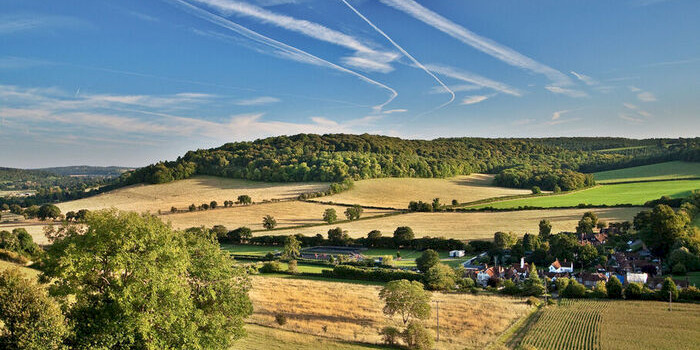



Didcot is a practical town and most people who live here would tell you it does the job well. But for buyers who want a bit more character, a village pub within walking distance, or simply fields outside the window rather than a housing estate, the surrounding villages are well worth considering.
There are quite a few to choose from, and they vary a lot in terms of price, feel and how connected they are to Didcot and beyond. Here is a rundown of the most popular ones.
Harwell
Harwell village sits about two miles west of Didcot and is probably the most in-demand of all the surrounding villages, largely because of its proximity to the Harwell Science Campus. That said, the village itself predates the campus by several centuries and has plenty going for it on its own terms. There is a good primary school, a village shop, a pub and a strong community feel. Properties here range from modern houses on small developments to older stone cottages, and average prices are higher than Didcot itself, typically coming in around £445,000.
The campus connection means there is consistent demand from scientists, researchers and contractors who want to walk or cycle to work rather than drive. That keeps the market competitive, and good properties here tend not to hang around for long.
Blewbury
Blewbury is around two and a half miles south of Didcot, sitting right at the foot of the Ridgeway. The poet John Betjeman described it as the quintessential Berkshire village, and while it has been part of Oxfordshire since 1974, the description still holds. It is genuinely pretty, with thatched cottages, a stream running through the older part of the village, a church, a pub and walking access onto the Downs straight from your door.
It is the kind of place people move to and never leave. Properties come up infrequently and there is not much new build stock, so the market is mostly older housing. That includes a fair number of thatched properties, which are worth bearing in mind from a mortgage perspective. Fewer lenders will consider them and specialist surveys are often required, so it is worth checking your options with a broker before falling in love with one.
Sutton Courtenay
Sutton Courtenay sits about three miles northwest of Didcot on the south bank of the Thames. It is a village with genuine history: the Abbey, the Norman church and the Manor House all date back centuries. Eric Blair, better known as George Orwell, is buried in the churchyard, and Herbert Asquith, former Prime Minister, also has connections to the village.
Day to day it is a quiet, well-kept place with a good village school, a couple of pubs and easy access to the Thames Path. Average prices sit around £543,000, reflecting both the character of the housing stock and the demand from buyers who want something distinctive. Didcot Parkway is around a 15 minute drive, making it workable for commuters.
Long Wittenham
Long Wittenham is a small, quiet village about three miles north of Didcot, sitting between the Thames and the Berkshire Downs. It has a village primary school, a pub (The Machine Man), a village hall and a strong local community. It is popular with families who want a genuinely rural feel without being too far from Didcot's amenities or the A34.
Because it is smaller and less well-known than some of the other villages, properties here can sometimes represent better value than Harwell or Sutton Courtenay, though the market is thin and transactions do not happen often.
Steventon
Steventon is a village about four miles west of Didcot with a slightly different character to the others. It has a good primary school, a village shop, a pub and a regular bus connection to Didcot and Abingdon. The housing stock is a reasonable mix of older and newer properties, which tends to mean a slightly wider range of price points than the more characterful villages.
It is popular with families looking for village life without paying the premium that comes with somewhere like Blewbury or Sutton Courtenay.
East Hagbourne
East Hagbourne is probably the least talked about of the villages close to Didcot, but it deserves a mention. It is only about a mile and a half from the edge of town, making it the easiest commute back into Didcot of any of the villages here. It has a lovely Norman church, a village green, a pub and some genuinely attractive older properties. For buyers who want a village feel without actually being that far from town, it is worth a look.
A note on mortgages in the villages
A few things are worth knowing if you are seriously considering a village property. Older stock in this area includes a meaningful proportion of thatched cottages, listed buildings and non-standard construction. These can limit the pool of lenders willing to offer a mortgage, and valuations can be less straightforward than on a modern house. That does not make them unmortgageable, but it does mean getting advice from a broker before you make an offer, rather than after, is a sensible step.
Village properties also tend to transact less frequently than town properties, which can make comparable valuations harder and occasionally creates a mismatch between asking prices and what lenders will accept. Again, worth knowing early rather than discovering mid-purchase.
If you are considering any of the villages around Didcot and want to understand your mortgage options before you start viewing, we are happy to have a chat.
Frequently Asked Questions
All of the villages covered here are within around 15 to 20 minutes of Didcot Parkway by car, which gives you access to direct trains to London Paddington in around 40 to 55 minutes. Harwell and East Hagbourne are the closest to town, which can make the morning drive to the station slightly easier. That said, the difference in commute time between the villages is small, and for most buyers the character and price of a village are likely to matter more than a few minutes either way.