












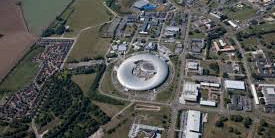



Most people who don't work there drive past the Harwell Campus signs on the A34 without giving it much thought. But if you live in Didcot or you're thinking about moving here, it's worth understanding what's happening at Harwell, because the scale of what's being built is significant, and it has a real bearing on the area around it.
What is Harwell Campus?
Harwell Science and Innovation Campus sits about two miles outside Didcot, just off the A34. It covers 700 acres and is home to over 240 organisations working across space, quantum computing, life sciences, clean energy and advanced manufacturing. The UK Space Agency, Diamond Light Source (the UK's national synchrotron facility), the UK Atomic Energy Authority and, more recently, Moderna's UK vaccine manufacturing facility are all based there.
Over the past two years alone, the campus community has grown from 6,000 to 7,500 people. In 2025, 33 companies chose to move to or expand at Harwell, including QuEra Computing which opened a UK hub for commercial quantum computing, and Amber Therapeutics, which relocated its headquarters there following a significant funding raise.
It is, quietly, one of the most consequential employment sites in the south of England.
And it's about to get a lot bigger
In October 2025, the Crown Estate announced plans for a £4.5 billion science and technology district at Harwell East, on 221 acres of land adjacent to the existing campus. The plans include up to 4.5 million square feet of new lab, office and advanced manufacturing space, as well as around 400 new homes. When fully developed, Harwell East is expected to support around 30,000 jobs and contribute £2.5 billion to the economy.
Separately, the existing campus has its own masterplan to deliver an additional 4 million square feet of space, and the Harwell Quantum Cluster launched in late 2025 with ambitions to attract over 100 quantum companies, 1,000 high-value jobs and £1 billion of investment over the next decade. The government has already put £670 million behind quantum computing at Harwell.
This isn't a planning aspiration. It's a fully-funded, government-backed expansion with work already underway.
What does this mean for people living in Didcot?
The most direct effect is jobs. Harwell already employs thousands of people across highly-skilled, well-paid roles in science, engineering and technology. As the campus grows, more of those people will need somewhere to live, and for many of them Didcot is the obvious answer. It's the nearest town with good transport links, a growing range of amenities and housing stock at a range of price points.
The Harwell Connector bus runs up to four times an hour between Didcot Parkway and the campus on weekdays, and the campus itself is around a 10-minute drive. For people who can't or don't want to live in Oxford or one of the nearby villages, Didcot makes a lot of sense.
There's also a broader effect on the local economy. A growing, well-paid workforce supports local businesses, restaurants, schools and services. The campus has acknowledged this directly in its own future vision documents, noting that new residential communities are emerging at Didcot and Wantage and that infrastructure needs to be upgraded to better connect the campus to surrounding areas.
What about the villages?
Harwell village itself sits right next to the campus and has always attracted people who want to be close to work but prefer a quieter setting. Chilton, East Hendred, Wantage and the villages around Sutton Courtenay are also popular with campus workers. These are generally more expensive than Didcot, and properties in some of these villages can be harder to mortgage depending on their age and construction, but demand is consistent.
The bigger picture
Harwell sits within what's increasingly referred to as the Oxford-Cambridge Growth Corridor, a government-backed strategic area intended to drive science, technology and innovation investment across a swathe of the country. Didcot is positioned right in the middle of this. That context doesn't guarantee anything about property values or the pace of development, and anyone making decisions about where to buy or invest should do so based on their own circumstances and proper advice. But it does explain why this part of Oxfordshire keeps appearing on the radar for people looking to relocate or put down roots.
If you're moving to the area for work at Harwell or one of the surrounding organisations, or if you're already local and thinking about what the changes mean for you, we're happy to have a chat about your mortgage options.
Frequently Asked Questions
Didcot is one of the most practical options for people working at Harwell. The campus is around two miles away, roughly a 10-minute drive, and there's a regular bus service from Didcot Parkway. The town has a wider range of housing than the nearby villages, and Didcot Parkway gives you direct rail access to London Paddington in around 40 minutes and Oxford in about 15. Whether it's the right fit for you depends on your own priorities, but it's one of the most commonly chosen locations for campus workers.